Five layers that make the model replicable, and six phases every deployment moves through. This is the operational shape of the program, not a curriculum outline.
We put medical and pre-medical students into rural and underserved communities as Digital Health Navigators. They work with patients who self-identify as not digital health savvy. For many people, this is a first step, but an important one, into using the telehealth tools, patient portals, and remote monitoring devices their care now depends on.
DRHC plugs into the infrastructure a community already has, whether that's an AHEC network, a state agency, or an academic partner. No new layer to bolt on. IRB-approved patient and student data is generated along the way.
The learning runs both ways. Patients learn how to use the tools their care depends on. Students learn what rural care looks like from the patient's side, an experience that research shows increases the likelihood they'll practice rural medicine. The field gets a growing evidence base on the real barriers people face when trying to access care online.
DRHC isn't a curriculum. It isn't an app, a training, or a toolkit. It's all of those, deployed inside one operational framework that doesn't exist elsewhere.
We've looked. Telehealth training programs exist. Rural health electives exist. Community health worker programs exist. None of them integrate the elements that make DRHC work as a single, replicable system.
DRHC plugs into the infrastructure partners already have. It targets the right counties, not regions in the abstract. And the data it generates are built to feed state and national policy, not just academic publication. The five layers below show how.
The framework delivers in five layers.
The theory, model, logic, and outcomes framework. Written so a state director, an AHEC partner, an academic lead, or a funder can defend the program without being in the room when it was built.
The operational guide. Step by step, discovery through deployment through reporting.
Every instrument and material organized for immediate use: the FieldHub mobile app, the State Deployment Navigator, the training curriculum, scout reports, recruitment materials, and the reflection capture system.
Multi-site IRB template, IRB-approved eHEALS patient survey instrument, structured student reflection system, and the publication pathway through AMSA's open-access journal.
How your team gets operational and what continuing access looks like once you're live.
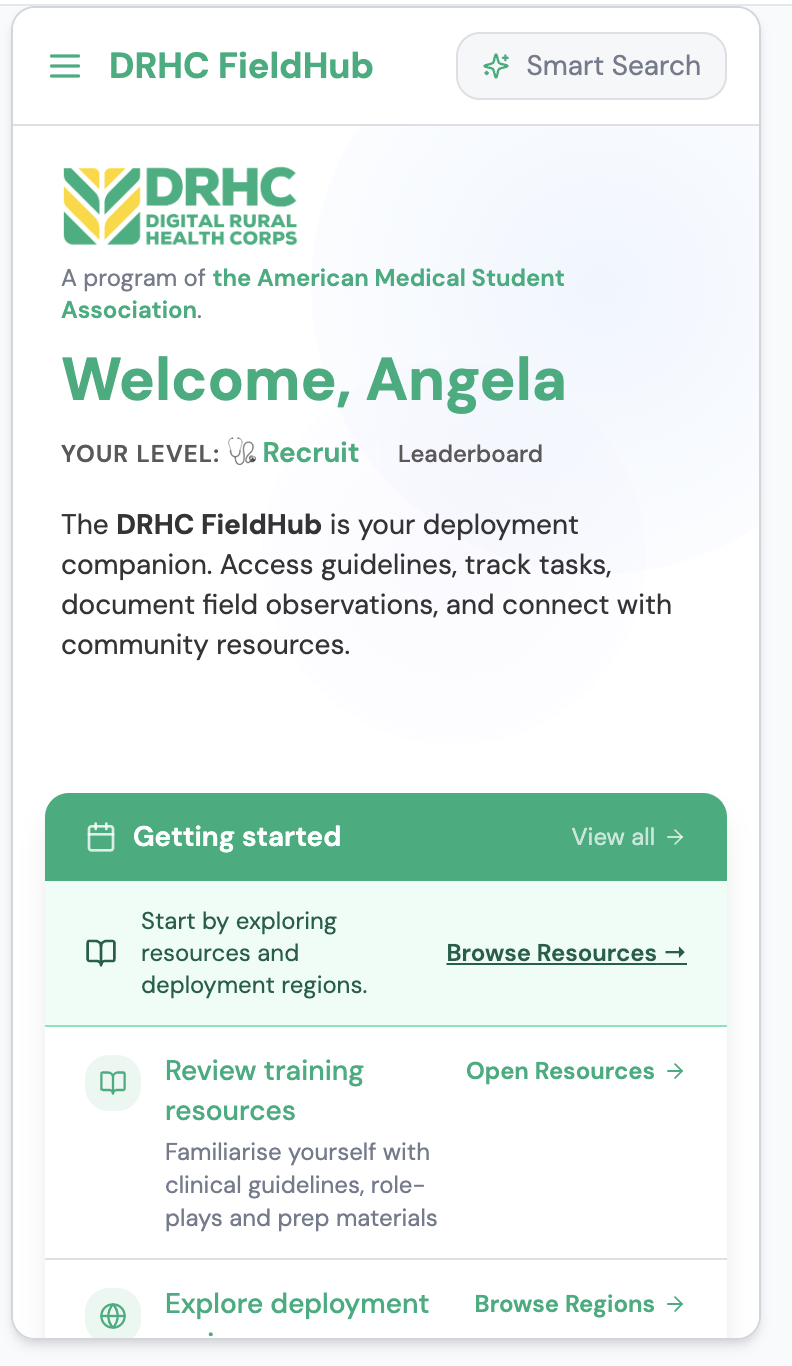
DRHC FieldHub · v1 · in field use
Every student navigator carries the same toolset into the field: protocols, scripts, encounter capture, and sponsor attribution in one place. Built for the realities of rural broadband and short patient windows.
The value isn't in the documents. It's in the system: the framework, the network, the data infrastructure, and the senior expertise to deploy it well and improve it over time. Partners don't buy a binder. They license access to a living program.
Every DRHC deployment moves through six phases. The Playbook documents each one in detail; this is the shape.
Structured workshop with your team. Priority counties, FQHCs, rural hospitals, health departments, deployment sites. In Georgia, this produced a map across six AHEC regions.
Students recruited from AMSA chapters and/or medical schools in your state or region. A 90-minute training session orients them to the framework, the FieldHub app, navigation protocols, and data collection. In person or virtual.
Trained students show up at their assigned sites as Digital Health Navigators. The FieldHub app guides their work and captures deployment data.
Patient survey data via the eHEALS instrument. Student reflections via a structured prompt system. Both streams preserved for analysis and research.
Deployment data becomes regional and state-level insights. Students with research interest get the AMSA publication pathway. Policy-relevant findings are documented and made available to your partners.
Deployment-specific learnings feed the next cycle. System-wide improvements get shared across the network.