One live training session certifies you. You can use it the same week, from wherever you are, and what you record becomes part of a research base that barely exists yet.
Rural patients are told to check the portal. Book the telehealth visit. Refill through the app.
For millions of them, that is where care stops. Not because the broadband isn't there, but because no one is.
Most physicians never learn this. They prescribe the portal and never find out what happened next.
You will.
You will sit with people as they try to use the systems their care now runs on, and you will watch exactly where it breaks. That understanding does not expire when you match. It shapes how you practice, what you assume about your patients, and what you refuse to accept as normal, for the length of a career.
The literature on rural digital health navigation is genuinely thin. We know, because we went looking. DRHC was structured to change that on two fronts: original data from the field, and the review work that maps what is already known. Both need students. Neither requires you to be in a lab state.
DRHC draws on three sources at once: the field data students capture, a running study of how individual states are addressing the digital divide, and the literature reviews students build. Those feed policy recommendations. Students who want to be on that work are on it. This is the drafting side of health policy, not a briefing about it.
Navigation is how the work gets done. It isn't the claim. No one thinks a medical student at a kitchen table closes the digital health divide. What closes it is a generation of physicians who understand the problem clinically, a body of evidence that did not exist before, and policy built on both. This is a way into all three.
That's it. One live session, held on a rolling schedule, open to pre-med and medical students alike. No year restrictions, no prerequisites.
The hour is the doorway, not the destination. We push every trainee on practice, role-playing the actual conversations, out loud, more than once. The skill lives in the repetition, not in the session.
You are certified on completion of training. No deployment required. More than 300 students have been trained so far, and the number climbs every month.
DRHC runs on AMSA membership. Nothing else about the program costs a dollar. Not the training, not the app, not the research.
In Georgia and Ohio, we have already funded your membership. Grant money we secured covers it outright, so joining costs you nothing at all.
Everywhere else, membership is the one thing we ask you to bring, and we are actively pursuing the same funding in every state we expand into.
This is the part students underestimate.
You do not need a lab state, a deployment schedule, or a permission slip to put this to work. You need one person who has been putting off a telehealth appointment because the setup screen defeated them.
Start with your own grandmother. Your uncle who won't call the pharmacy. A neighbor, a family friend, the person at your parents' church who mentioned the portal password thing and then changed the subject.
Sit down with them. Use what you learned. You will find out fast that the barrier is rarely the one you expected, and that is the lesson the training exists to deliver.
You do not need a deployment to be on this work.
Your field observations are data, captured formally. Every time you sit with someone and work through a portal, a telehealth setup, a prescription app, you record what you saw: where it broke, what actually helped, what surprised you. Speak it or type it into FieldHub, our app. Audio gets transcribed, entries get tagged, and everything lands in a structured database that grows with every session logged. Every trained student gets access.
This is not a journal you keep for yourself. It is one of DRHC's two research streams, it is collected the same way everywhere, and it is not confined to the lab states. Help your grandmother from an apartment in a state with no deployment schedule, log it properly, and you are in the dataset.
The review work is entirely location-independent. The evidence base needs building, and that is where a lot of students find their first publication.
If you want research and publishing experience and you are nowhere near a deployment site, this is your entry point, not a placeholder until something better opens up.
Patient-level survey data is a separate stream, collected under IRB-approved protocol at active deployment sites. See below.
Scheduled deployments · IRB-approved protocol
Both states run scheduled deployments into rural communities: libraries, pharmacies, senior centers, farmers markets, churches, community centers, and hospital discharge points. confirm site list is current
On deployment you work one-on-one with community members, log sessions in FieldHub as you would anywhere, and administer the eHEALS patient survey under IRB-approved protocol, the second data stream and the one that requires an approved site.
IRB approval in place
Illinois has IRB approval in place, with deployment activity expected to resume.
If you are in Georgia, Ohio, or Illinois: note your state on the interest form below and you will be routed straight to that state's team.
Get trained. Then reach out.
Students are how new states open. That is not a flourish, it is the actual sequence. When you raise your hand, we pursue IRB approval in your state and work through what it takes with you: community partners, site selection, the institutional pieces. You do not need prior experience or a title. You need to want it.
That is how Georgia, Ohio, and Illinois happened. The next one is somebody reading this.
Tell us on the interest form that you want to lead.
Sohawm did this.
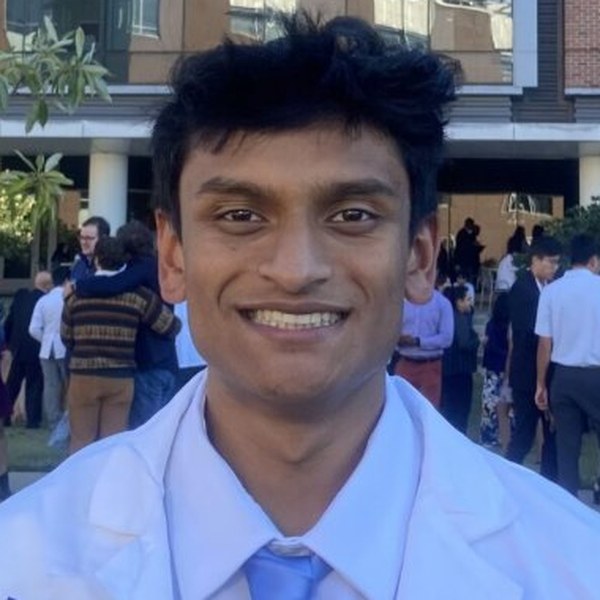
Sohawm's cut drops in here, with captions, once it lands.
Sohawm Sengupta · DRHC Georgia State Lead · Medical College of Georgia · Fourth-year MD/MPH candidate
Do both. The form tells us you exist. The session tells you whether this is yours.
Tell us who you are, where you are, and what pulls you: fieldwork, research, policy, or all of it. Students in Georgia, Ohio, and Illinois are routed directly to their state teams.
Live, rolling, low-commitment. Bring questions and decide afterward. Next session: Loading…
Student AMSA membership in our lab states is covered by secured grant funding. If you are interested in funding student membership in an expansion state, we would like to hear from you. Get in touch.